

Learn how to optimize your resume to increase your chances of getting hired through a Greenhouse ATS.
Key Takeaways
- Humans, Not Robots: Greenhouse does not auto-reject or score your resume using algorithms; every rejection is a manual decision made by a human recruiter.
- The Scorecard System: Hiring managers create a “scorecard” of specific skills and traits; your application is manually graded against these “Focus Attributes.”
- Searchable but Visual: While the system parses your data so recruiters can find you via keywords, they ultimately view your original resume file for the final evaluation.
- Structured Interviews: The software uses “Interview Kits” to ensure every candidate is asked the same questions, moving away from “gut feelings” toward data-driven hiring.
- Strategic Tailoring: To win, mirror the specific nouns and verbs found in the job description, as these are likely the exact categories listed on the recruiter’s internal scorecard.
Since its launch in 2012, Greenhouse has grown to become a major player in the applicant tracking systems (ATS) market.
The biggest misconception about the Greenhouse ATS is that a robot is auto-rejecting your application.
The reality is much more nuanced: Greenhouse doesn’t score you with a machine; it feeds your parsed data into a customized “Focus Attributes” scorecard for human recruiters to grade.
If you want to optimize for this specific system, you need to understand exactly what the hiring manager sees on their dashboard—and how to reverse-engineer your application to match their standardized interview packages.
Companies that use Greenhouse ATS
Here are just a few of the 7,500 companies and organizations around the world that now use Greenhouse.
- Airbnb
- DoorDash
- DocuSign
- Cisco
- Dropbox
- Evernote
- Foursquare
- Instacart
- Hubspot
- NerdWallet
- Stripe
- Snapchat
- Lyft
- Oscar Health
- Squarespace
- Wayfair
- Slack
- Vimeo
- Warby Parker
- Betterment
- TripAdvisor
- GoDaddy
- Motor Trend Group
Using Jobscan data, we analyzed job descriptions from over 12,000 companies where an ATS was detected to see which ATS they use. And Greenhouse was used by almost 20% of companies.
Clearly, Greenhouse is popular with a lot of big, well-known companies. But why should you, as a job seeker, care about how Greenhouse works?
Because it can have an impact on your job application process and overall candidate experience.
The more you know about Greenhouse, the better you’ll be able to optimize your resume for companies that use it. This will give you a significant advantage over other job applicants.
With this in mind, let’s take a deeper look at the Greenhouse applicant tracking system and how it works.

Land more job interviews with resume scanner. It’s quick and easy.
How does Greenhouse ATS read your resume?
When you submit your resume to most applicant tracking systems, the first thing they do is parse it.
Parsing is when an ATS algorithm analyzes the structure and content of your resume. It then extracts relevant information, such as skills, education, and work experience.
This extracted data is stored in a database. Hiring managers can then search, filter, and sort candidates in the database.
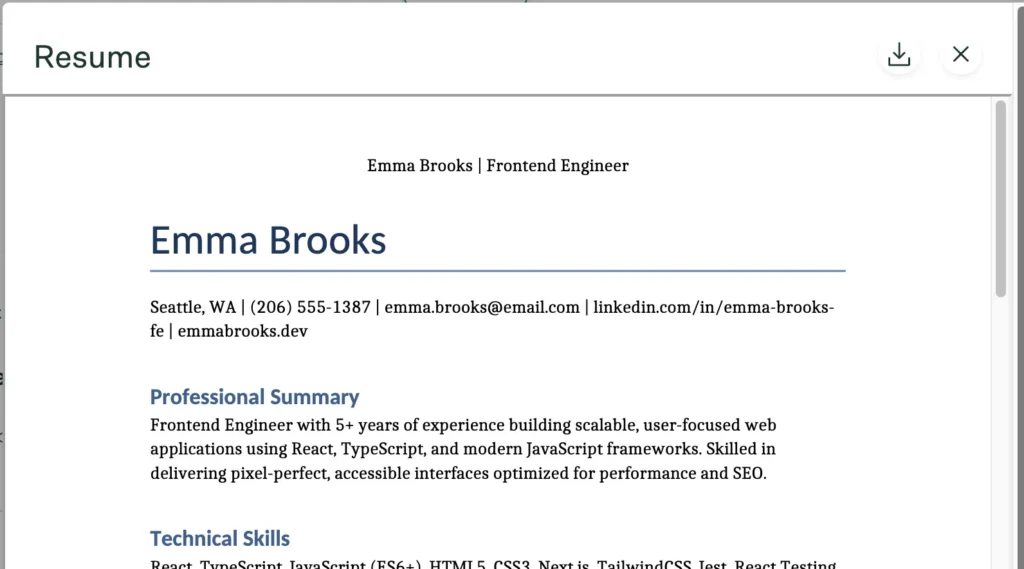
Greenhouse combines this extracted data with a focus on human readability by housing the complete resume file (and making the entire document searchable).
With Greenhouse, hiring managers work with parsed data, making an ATS-friendly resume incredibly important to being found in searches, but once they find you in their system, they see your resume exactly as you have submitted it with more depth.
In other words, they’ll see a full image of your resume that they can scan with their own eyes.
How does Greenhouse ATS score your resume?
Some ATS systems generate a score or ranking based on the data that’s been parsed from your resume. But Greenhouse doesn’t score resumes.
Why? Because a score may not capture all relevant qualifications or factors that could be important in the hiring decision.
“Everyone’s resume is wildly different in what they write and how they write it,” says Daniel Chait, CEO and Co-founder of Greenhouse.
“Any kind of automated scoring system of a document like that is subject to the biases of the people who are building the algorithm and the data that’s used to train that algorithm or that scoring system.”
Chait believes that any kind of scoring is “a task better left to the hiring managers and the teams looking for the people.”
Why Greenhouse doesn’t auto-reject (and what it actually does)
In Greenhouse, the “black hole” of automatic rejection is largely a myth; the system is architected around structured hiring, which prioritizes human calibration over algorithmic dismissal. Greenhouse does not use “bot” scoring to summarily delete resumes based on keyword density.
Greenhouse is one of many systems out there. For more general understanding of ATS software, learn what an applicant tracking system is.
Greenhouse is designed as a decision-support tool, not a decision-maker—meaning every rejection is a deliberate action taken by a user within the system’s structured interview plan.
How the Greenhouse scorecard works
Greenhouse does score candidates, but as Daniel Chait indicates, human beings do the scoring, not an algorithm. It works like this:
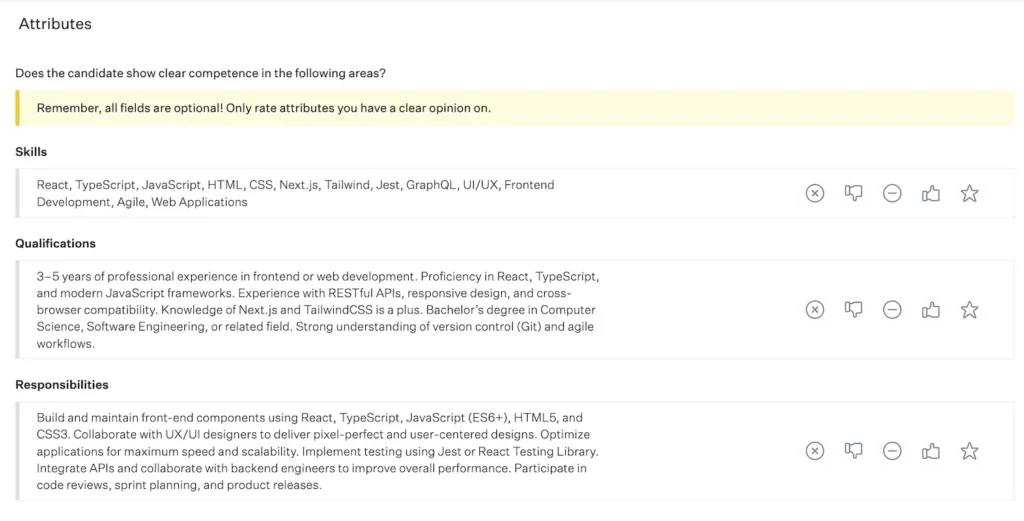
Greenhouse provides its users with a “scorecard” template. When hiring managers post a new job, they fill in this template by creating a list of skills and qualifications that the ideal candidate should possess.
The hiring manager then reviews a candidate’s application and assigns a score. This score is based on each competency or skill listed in the scorecard template.
The scores for each competency are then aggregated into an overall score for the candidate.
One of the benefits of doing it this way is that multiple people in the company can score candidates independently. This provides a more objective evaluation as opposed to a single score generated by an ATS.
You can actually get a good idea of how your application will score before you apply for a specific job. How?
By using resume scanner. This tool uses ATS technology to analyze your resume and compare it to the job listing you want to apply for.
If your resume scores highly with resume, it’s much more likely to impress the hiring managers who use Greenhouse, or any other ATS.
How the “Focus Attributes” field works
In the Greenhouse ecosystem, Focus Attributes serve as the mechanical “cheat sheet” for interviewers, ensuring that every stage of the hiring plan remains objective and targeted. During the job setup phase, hiring managers define a comprehensive list of skills, traits, and qualifications. However, instead of overwhelming every interviewer with the entire list, they use Focus Attributes to assign specific subsets to individual interview stages.
When an interviewer opens a candidate’s scorecard, the Focus Attributes are highlighted at the top to signal exactly which criteria they are responsible for evaluating. This eliminates “evaluative overlap,” where four different people ask the same technical questions while ignoring soft skills.
Here’s exactly what a hiring manager sees on their screen.
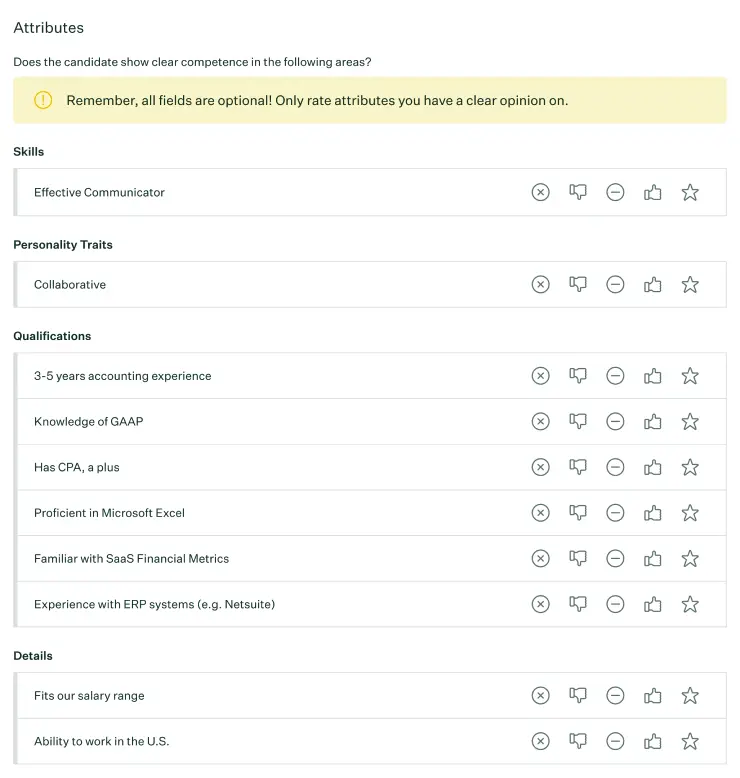
The mechanics function as follows:
- Weighting and Selection: Recruiters select specific attributes from the global job profile to be “focused” for a particular interview (e.g., the Initial Phone Screen might focus on “Salary Expectations” and “Culture Fit,” while the Technical Assessment focuses on “Python Proficiency”).
- The Rating Scale: Interviewers provide a score for each Focus Attribute using a scale: Strong No, No, Yes, and Strong Yes.
- Aggregated Scoring: These individual attribute ratings feed into the “Overall Recommendation.” While Greenhouse doesn’t use a mathematical average to determine a hire, the Focus Attributes provide the granular data points that hiring managers use in later stages to compare candidates side-by-side on a standardized grid.
That would look something like this:
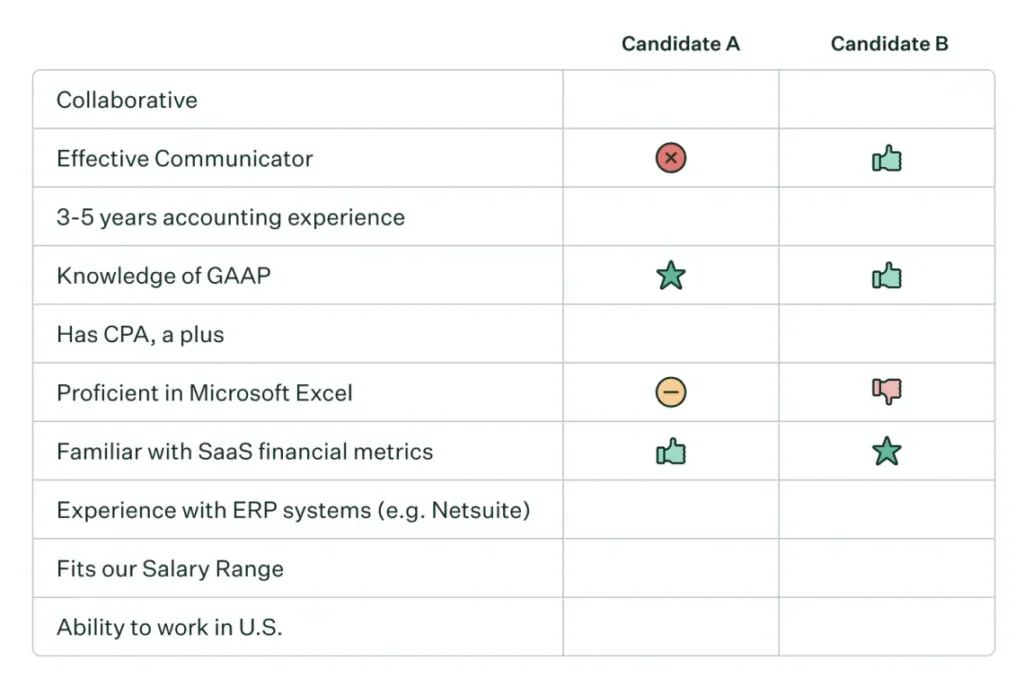
By hard-coding these attributes into the workflow, Greenhouse forces a data-driven approach, preventing interviewers from relying on “gut feelings” and keeping the feedback loop focused strictly on the requirements defined in the initial Interview Plan.
Tailoring your resume for Greenhouse ATS and standardized interview packages
When tailoring for a Greenhouse-backed application, you are not writing for an “algorithm” that ranks you 1–100; you are writing for a parser and a structured scorecard. The goal is to ensure your data populates the “Candidate Profile” fields accurately so that when the recruiter pulls up your digital folder, the information is where they expect it to be.
Greenhouse utilizes Interview Kits, which are standardized sets of instructions and questions sent to every interviewer. These kits are directly derived from the Job Setup attributes. To tailor effectively:
- Mirror the “Focus Attributes”: Analyze the job description for specific nouns and verbs. These are almost certainly the exact labels used on the internal scorecard. If “Conflict Resolution” is listed as a requirement, it likely has its own dedicated rating star on the interviewer’s screen.
- Prepare for “Evidence-Based” Feedback: Greenhouse encourages interviewers to provide specific “evidence” (notes) for every score they give. Write your resume bullets as mini-STAR (Situation, Task, Action, Result) statements. This makes it easier for a recruiter to copy/paste your achievements directly into the “Pros” section of their initial screen scorecard.
Keyword optimization matters.
That’s why you still need a strong ATS resume strategy to land you interviews

Try the resume scanner for free
Compare your resume to your target job description and make sure you’re positioning yourself as a must-interview candidate.
While Greenhouse doesn’t use scoring, some of those 450 integrations include plug-ins that score resumes. Bigger companies may be using them to help manage large volumes of resumes. This makes keyword targeting an essential step in your resume writing strategy!
Does Greenhouse ATS use AI?
AI adds another layer of uncertainty to the hiring process. The “black box” that already existed in hiring with the ATS is now more opaque with AI.
Many ATS companies, like Greenhouse, are now integrating AI features into their platforms. But what is AI really doing?
Greenhouse ATS AI features
AI, according to Greenhouse, should support recruiters. But it’s not designed to make decisions for them. So, Greenhouse’s AI doesn’t accept or reject candidates, give them a score, or make any decisions about which resumes get in front of decision-makers.
Here’s how Greenhouse utilizes AI in their ATS.
Greenhouse ATS AI helps recruiters:
- Write better job descriptions to accurately describe the role, responsibilities, and qualifications.
- Draft standardized and consistent interview questions to assess candidates more fairly.
- Develop a scorecard to help recruiters systematically measure proficiencies so every candidate is evaluated to the same standard.
- Anonymize resumes to highlight skills, qualifications, and experience and hide personal details.
- Suggests search terms for the recruiter as they look for candidates in the ATS.
- Summarize interview notes and feedback from the interviewer.
- Create automated emails at scale to send to candidates throughout the hiring cycle.
Find your job here.