

Your students’ resumes might be technically perfect—and still getting rejected.
Most career centers have standardized resume development around checklists and templates. While this approach seems efficient and scalable, the resulting resumes may not attract employer attention without something more: employer-centric resume coaching.
The gap between “correct” resumes and effective resumes is the difference between best practices and employer alignment. Shifting your approach to make each student application truly tailored to the specific job ad seems like a dream. But it is possible to do this at scale if you have the right tools at your disposal.
Where Universal Standards Fall Short
There are best practices for resumes that have been around for generations: format it neatly, use reverse chronological order, and proofread multiple times for grammar and spelling.
In the modern era, type size of 10-12 pts, summaries, and brevity are foundational. But in every industry, there have always been norms and best practices, and variation in what employers want and expect has always been a factor.
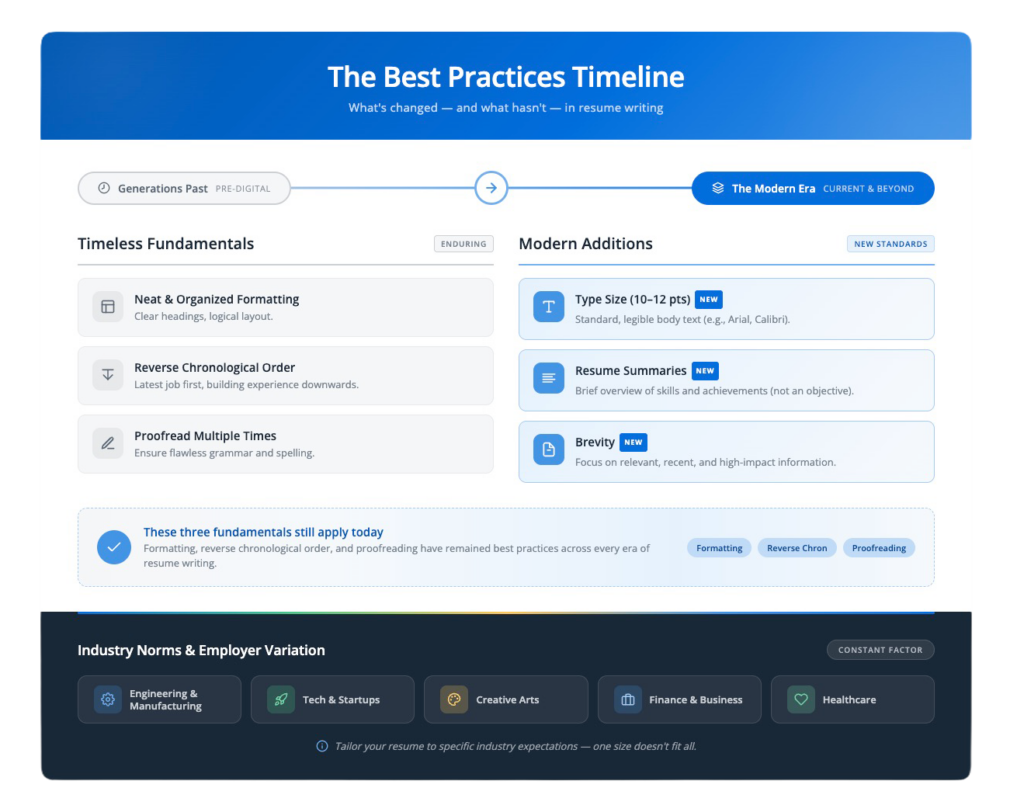
There has never been a fully universal standard for resumes, though foundational principles remain the same.
For career centers, helping students apply best practices to create solid, technically correct, and well-formatted resumes can seem safe. You can apply this to all students across all fields and at every level. These basic principles are absolutely necessary.
Career counselors can give consistent resume advice because these principles are easy to teach, and these “best practices” help reduce ambiguity. They don’t confuse students by suggesting there is no ideal resume for every job application.
And yet, this is where AI becomes a threat: students can increasingly get “best practices” resume advice from an LLM. If the career center is teaching the same fundamentals, what’s the differentiation?
Buried in there is a hidden assumption: that all employers evaluate resumes the same way.
Compensating for that assumption, some centers set a benchmark for students in each discipline, using AI to score every resume in that field using the same template, which leads to inconsistent scoring that isn’t reflective of the real world. Even with benchmarking for different departments’ students, these templates don’t account for the real-world jobs students are applying for.
As we are in the thick of the ATS era, career center professionals have the added burden of helping students optimize for the extra layer of scrutiny before a human sees the resume. The default would be to develop a “best practices” for ATS systems—a new universal standard. But the reality is that each ATS system evaluates resumes differently, and each hiring manager prioritizes different competencies.
Every job description tells you exactly what to emphasize. This necessitates that students tailor each application to the job description to pass the ATS resume screening. Career centers need to help all students learn how to do this.
What Employer Alignment Actually Means
Employer alignment means tailoring a resume to the specific language, priorities, and requirements of each job posting. There are four levels of alignment needed for outcome-based resume writing:
1. Skills alignment
Employer alignment means tailoring a resume to the specific language, priorities, and requirements of each job posting. There are four levels of alignment needed for outcome-based resume writing:
2. Competency alignment
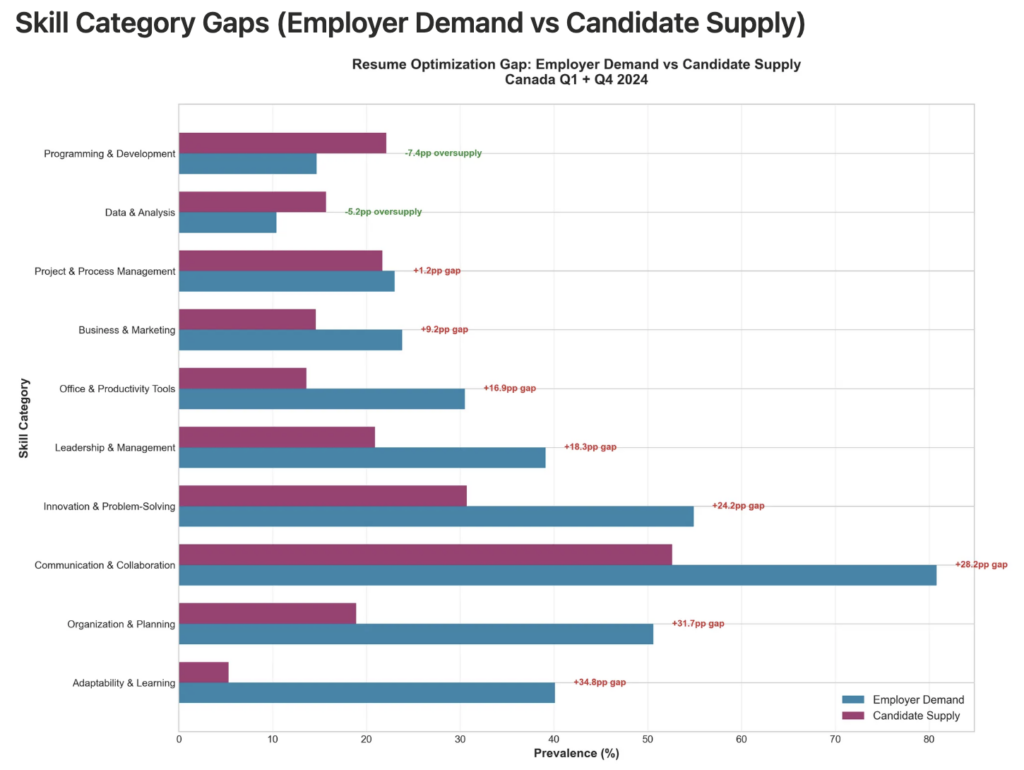
Highlighting experiences that clearly map to what the hiring team said they need, not just listing responsibilities. Recruiters evaluate based on signals that are highly variable. We teach students how to read between the lines and make smart probability bets about what matters most.
3. Signal prioritization
Knowing what’s core in a job description vs. what’s noise, and adjusting emphasis accordingly. Not every bullet point in a posting carries equal weight — students need to learn how to identify the requirements that actually drive hiring decisions and lead with those.
4. Hiring tech alignment
Preparing students for how applications are actually reviewed. Most organizations are using some kind of Workday, Lever, Greenhouse, different AI tools, etc. They don’t parse or surface applications the same way, nor are they used in a universal fashion. If we’re serious about outcomes, we can’t pretend they do.
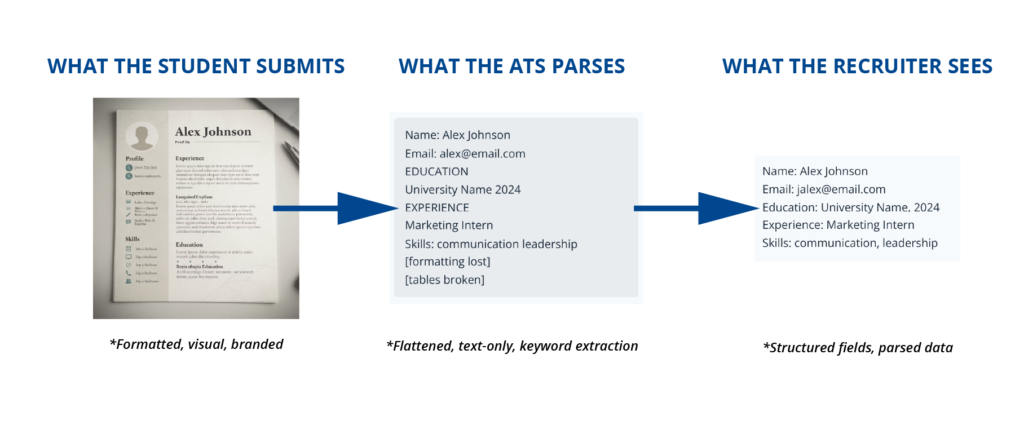
To manage application volume, most employers use Applicant Tracking Systems (ATS) and increasingly AI-assisted tools — software designed to organize, structure, and prioritize applications so recruiters can focus their time on qualified candidates rather than drowning in unstructured data. These systems aren’t obstacles; they’re organizational tools that help recruiters work efficiently. But because they vary widely in how they parse and rank applications, a one-size-fits-all resume strategy leaves outcomes on the table.
“We…matches the job you are applying for with the ATS that the company utilizes.” – The George Washington University School of Engineering and Applied Sciences.
One resume won’t get a student’s resume past the ATS gateway because the specific alignment with the employer’s requirements for the position will not be close enough. A resume that’s 60% aligned will consistently outperform one that’s 50% aligned, even if the 50% one is “perfectly formatted.” Teaching resume targeting strategies can produce better results.
Starting from a strong resume that accurately reflects a student’s experience, education, and competencies is just the start. Implementing employer-centric resume coaching is the next step.
Why Career Centers Default to Best Practices
Taking student resumes to the next level by tailoring them to the job description seems like a daunting task, and so choices are often made that land in the comfortable middle.
Career centers default to resume best practices because it can seem like the safest choice. Generic advice is easier to scale, and career advisors can’t become experts in every industry’s norms (Business, Software Engineering, and Liberal Arts?). Plus, one-on-one personalized guidance doesn’t scale to 500:1 caseloads.
These are legitimate constraints. Budgets are tight, and to succeed in the ATS-driven job-search climate, students will need to submit multiple applications.
The answer isn’t to abandon scalability—it’s to scale alignment rather than scaling generality. Teaching the basics of resume best practices is necessary for students who are less prepared for the workplace. However, by teaching students to understand alignment with job descriptions—and using tools to make this easier—you can achieve scalability.
Shifting the Paradigm: From Checklists to Alignment
Career centers can accomplish what seems insurmountable with a simple mindset shift. The question is no longer, “Is this resume correct?” Now, advisors need to teach students to ask, “Does this resume communicate to this employer?” What might initially seem like a lot more work actually just requires adopting a new perspective on how to teach students to succeed in their job searches.
Here’s how to make the shift:
Teach students to decode job descriptions, not just read them.
Students naturally default to the path of least resistance, but learning how to dig deeper to understand each position’s requirements is a step on the path to their future career.
Move from one-size-fits-all templates to job-description-responsive frameworks.
The template approach takes resumes only so far. Career centers need to raise placement rates by using tools and teaching skills that equip every student to respond to the specifics of each job listing.
Incorporate ATS literacy into the standard curriculum.
Career advisors don’t need to help tailor resumes to each job description once they teach students the skills they will need throughout their careers: critical thinking and analysis. In this case, students apply these competencies to gain employment, but they are increasingly important to employers across all industries.
This paradigm shift elevates the career advisor’s role by focusing on strategic career conversations instead of transactional resume formatting.
Technology can enable this shift at scale, with tools that analyze alignment rather than templates that ignore the specificity that employers require for each position. To succeed in the increasingly challenging job market for new graduates, aligning a student’s resume with the position is a decisive leg up in getting past the ATS and into the hiring manager’s view.
Career Outcomes Count
It’s undeniable: graduate placement rates are now indispensable for the success of not just the career center, but the college or university itself. The stakes are high: rankings, alumni success, and regulatory compliance with shifting gainful employment standards. Institutional survival is not a given for many, and the value of career services to the overall mission of higher education has become prominent. Centers need to use every tool available to improve metrics for internships and job placements.
Making the case to administrators can be straightforward. The climate of change is everywhere, and appropriately responding to the hiring environment is the right move. A shift in the paradigm is underway in academia, and career services is staying current with the times. Career services directors can say, “We’re not teaching resume writing differently—we’re teaching job search strategy that reflects how hiring actually works.”
The New Resume Best Practices
A tough job climate for recent graduates, combined with pressure on higher education institutions, makes ATS optimization the career center’s number one priority. Tackling the difficulties of resume tailoring at scale to meet the moment and get more students employed is central to raising metrics. The standard resume best practices remain constant, but reaching beyond them to leverage employer-centric resume coaching is achievable with the right tools and mindset.
Students with tailored resumes get more interviews, which leads to more offers and better employment outcomes. Employer alignment is what separates students who get interviews from students who don’t. Make your team the one that teaches students to think like employers, not just follow rules. This is an opportunity to supercharge the process and demonstrate the value of career services to move the needle on employment statistics for your college or university.
Best practices aren’t wrong—they’re just the floor, not the ceiling.
Give Jobscan A Try To See How It Aligns Employer Expectations To Student Resume
Find more resources for higher education career centers and plan your rollout.